What makes a security door kick-proof is not its appearance alone. Strength comes from the complete door assembly, including the slab, frame, hinges, locks, and wall connection. A heavy steel face can still fail when its frame pulls away from weak masonry. That detail is often overlooked.
Physical-security consultant Chris McGoey, CPP, emphasizes a practical principle: “Good security is layered security.” His observation applies directly to reinforced entry doors. A reliable design may combine a steel or solid-core slab, continuous hinge protection, a reinforced strike plate, and long fasteners anchored into structural framing. The frame should resist spreading, while the lock area needs additional steel reinforcement. Small gaps matter, too. They reveal poor alignment and reduce resistance.
Testing matters.
This guide examines ten security door types and the construction choices behind their performance. It considers steel security doors, composite models, commercial fire-rated assemblies, mesh doors, and reinforced residential systems. Each type has different strengths, limitations, costs, and installation demands. Some look formidable but depend on ordinary hinges or short screws. Others appear simple yet connect securely to the surrounding wall.
The phrase “What makes a security door kick-proof” needs careful handling. No door is permanently invulnerable, and “kick-proof” is not a universal engineering classification. Performance depends on tested assemblies, professional installation, maintenance, and the building itself. That may sound less dramatic, but it is more honest. Real protection begins where marketing claims end.
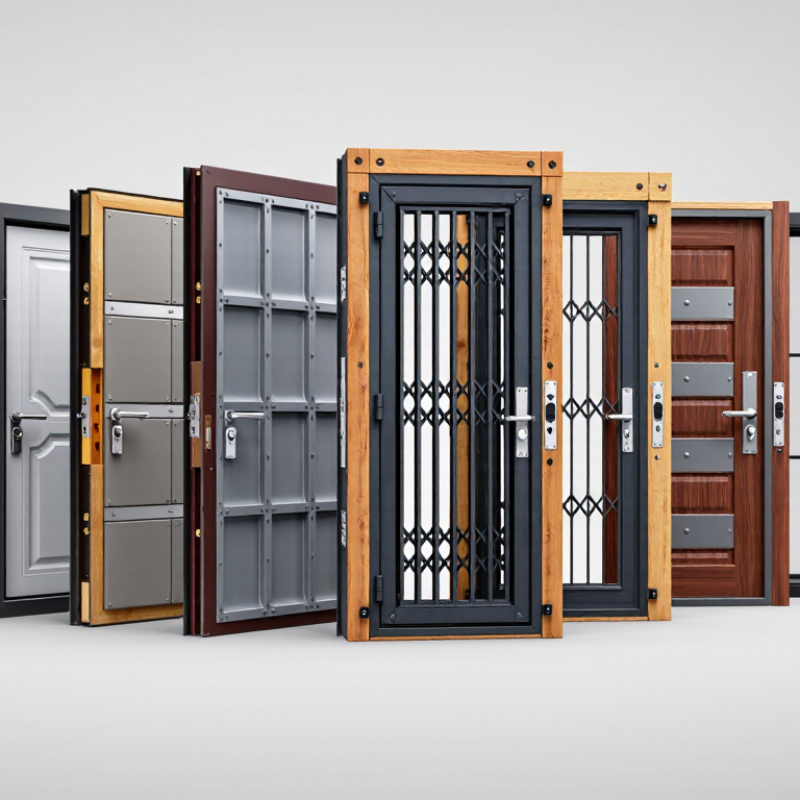
A security door is more than a heavy slab with a dramatic lock. It is a tested assembly of the door, frame, hinges, fasteners, lock, and surrounding wall. Steel, solid-core timber, composite, and reinforced-glass doors can offer different strengths. Kick-proof performance comes from how these parts share impact. A reinforced door may resist flexing, but weak jambs can still split. Frames fail too.
A practical inspection checks the latch side, hinge side, threshold, and strike area. Look for continuous reinforcement behind the lock and hinge plates. Multiple locking points can spread force across the frame. Heavy-duty hinges should resist sagging and forced separation. The door should close evenly, without a large gap at the floor or jamb. Glazing needs its own security design, because vulnerable glass can weaken the entire barrier. Installation quality is critical. Even excellent materials perform poorly when anchors miss structural framing.
“Kick-proof” is not an absolute promise. It usually means improved resistance under defined impact tests, not immunity to every attack. Test reports, installation instructions, and maintenance records provide stronger evidence than weight alone. It is easy to overrate a thick door and overlook the wall around it. That part matters. A balanced design should also consider fire performance, emergency exit needs, weather seals, and daily usability. Security should not create a dangerous delay during an emergency.
Choosing a security door starts with the threat you actually face, not the heaviest product available. A reinforced steel door suits exposed entrances, workshops, and ground-floor apartments. Its strength depends on the frame, hinge bolts, and a properly fitted strike plate. A thick slab alone is not enough. No door is truly kick-proof. Resistance comes from the complete door-and-wall system. For homes needing visibility, a security screen door offers airflow and daylight while adding a locked barrier. Use tamper-resistant mesh and a rigid perimeter frame.
Solid-core timber doors fit quieter residential settings where appearance and moderate resistance matter. They can feel welcoming, but weak frames may undermine them. For offices or shared buildings, a fire-rated security door may balance evacuation requirements with controlled access. Check its tested rating and compatible hardware before installation. In damp or coastal areas, corrosion-resistant finishes and stainless fixings deserve attention. Small rust spots can become expensive failures.
For high-value rooms or records areas, doors with tested impact or forced-entry ratings provide more measurable protection. Ask for certification details, test conditions, and installation limits. A qualified installer should anchor the frame into sound structure, align the hinges, and verify latch engagement. I have seen strong doors perform poorly because the surrounding wall flexed. That mistake is easy to miss. Review daily use, too. A door that sticks is often propped open, reducing security. Choose the type that matches the occupants, climate, traffic, and realistic risks, then inspect it after installation.
A kick-resistant door begins with its materials, not its appearance. Steel skins spread impact across the door surface. A solid core limits crushing and flexing near the lock. However, thin steel can still bend when the frame is weak.
Reinforced fiberglass offers another useful balance. It resists moisture, corrosion, and repeated impacts without becoming extremely heavy. Layered solid wood can also perform well, especially when dense timber surrounds a strong internal core. Yet wood may swell or shrink with seasonal humidity. That detail is easy to overlook.
In practical inspections, the frame often decides whether the assembly succeeds. A reinforced frame, long fixing screws, and a protected strike area help transfer force into the wall. Hinges need similar support, especially on outward-opening doors. Laminated security glass can reduce a vulnerable opening beside the lock. No material is magic. Even a heavy door may fail if installation leaves gaps or uses weak fasteners. Certified impact testing gives better evidence than weight alone, although real buildings rarely behave perfectly. Door selection should consider climate, wall construction, maintenance, and daily use. A secure door must remain aligned, closed, and easy for authorized occupants to operate.
A security door is never truly kick-proof. Its performance depends on the entire doorset, especially the frame and wall connection. The FBI Crime Data Explorer estimated 847,522 burglary offenses in the United States during 2022. That figure makes weak installation difficult to ignore.
Frames are the foundation. A heavy door can still fail when thin steel bends beside the strike. During inspections, small gaps often reveal more than the door’s advertised thickness. Hinges need protected pins, reinforced leaves, and fasteners reaching structural material. Decorative screws are not enough. Small gaps matter.
Locks must transfer force into the frame, not merely resist picking. ANSI/BHMA A156.13 covers important mortise-lock strength and durability tests, but it does not certify every installed doorway. Anchors matter just as much. They should connect the frame to masonry, concrete, or properly reinforced framing, rather than loose trim. EN 1627 evaluates complete doorsets through graded resistance testing, which is a useful reminder: a strong lock cannot rescue a weak frame. One practical mistake is specifying components separately, then assuming they will perform as a system. They may not. A site review should check hinge-side reinforcement, strike depth, anchor spacing, wall condition, and installation tolerances. The weakest connection usually decides the outcome.
Security performance depends on the complete door assembly—not only the door slab. This comparison counts four commonly specified protective elements: a reinforced frame, three or more heavy-duty hinges, a multi-point lock, and structural frame anchors.
The score represents the number of these four design elements typically included in a security-focused configuration. It is a comparative design indicator, not a certified impact or forced-entry test result.
A kick-proof security door should resist the entire entry system, not only the door panel. The FBI Crime Data Explorer estimated 847,522 burglary offenses in the United States during 2023. That figure supports careful entry-point planning, but it does not prove every attack involves kicking. Marketing claims can be vague.
A strong steel slab can still fail when its frame twists or pulls from weak masonry. Look for reinforced hinge posts, a continuous strike area, long structural fasteners, and a multi-point locking system. The door should also carry tested resistance evidence, such as ASTM F1233 or EN 1627 classification. These standards examine forced-entry performance under controlled conditions. Ask for the test scope, not just a certificate number.
Check the door-to-frame gap with a flashlight. Large gaps invite leverage. A thin frame may flex under repeated impact. Glazing needs separate impact protection and secure bead retention. Do not ignore the wall connection; installers often treat it as an afterthought. That is a mistake. The National Institute of Standards and Technology emphasizes that installed performance depends on the complete building assembly, not one component. A practical evaluation should include installation quality, maintenance access, emergency egress, and local code requirements.
“Kick-proof” is not absolute. It is an incomplete, sometimes careless phrase.
It is a complete entry system. The door, frame, hinges, locks, fasteners, threshold, and wall connection work together.
Reinforced frames, strong hinges, secure locks, and structural fasteners spread impact. A thick panel alone is not enough.
Yes. A weak jamb or wall may split first. Weight can create false confidence.
Look for continuous reinforcement behind the strike area. Check whether long fasteners reach solid structural material.
Extremely important. A flexible frame can twist, pull away, or enlarge the door gap during repeated impacts.
Shine a flashlight around the jamb and floor. Large gaps may provide leverage. The inspection is simple, but easy to neglect.
No. It can distribute force across several locations, but weak anchors can still undermine the system.
Request controlled impact-test results, installation instructions, and maintenance records. A certificate number without scope tells very little.
It can. Glass needs impact protection and securely retained beads. One vulnerable panel may compromise the whole barrier.
Consider emergency exit needs, fire performance, weather seals, local requirements, and everyday operation. Security should not create a dangerous delay.
A security door is designed to withstand forced entry through a combination of structural strength, impact resistance, and reliable locking components. What makes a security door kick-proof is not one feature alone, but the way its reinforced core, durable outer material, heavy-duty frame, protected hinges, and secure anchors work together. Steel, reinforced metal, and solid composite materials can help prevent bending, cracking, or separation under repeated impact, while multi-point locks distribute pressure across the frame instead of concentrating it in one vulnerable area.
Different security door types serve different protection needs, including reinforced steel doors, metal mesh doors, solid-core composite doors, and high-security entry systems. When choosing one, evaluate the door’s construction, frame depth, hinge protection, lock quality, installation method, and resistance testing. A strong door can perform poorly if its frame or anchors are weak, so professional fitting and precise alignment are equally important. The best choice balances security, daily usability, ventilation, appearance, and long-term maintenance.

RZ door